You've spent months on your product. The drawings are ready, the samples are close, and a factory is asking for your files. This is the moment most first-time founders worry about: what stops them from making it for someone else?
The honest answer: a piece of paper won't stop everything. But the right agreement, signed at the right time, makes copying much less likely and much easier to act on. Here's how it works.
Why a standard NDA often isn't enough
Most founders reach for an NDA (non-disclosure agreement) from home. It's a natural first step, but it has two weak spots when you're working with a factory in China:
- It only covers sharing. An NDA says "don't tell anyone." The bigger risk usually isn't that the factory tells someone about your product. It's that they use your design themselves, or sell it straight to your customers.
- It's hard to enforce. An NDA written in English, under US law, is difficult to act on in China. If you ever need to take action, it has to work in a Chinese court.
What an NNN agreement covers
NNN stands for Non-disclosure, Non-use, Non-circumvention. It closes those gaps:
|
What it means |
What it stops |
| Non-disclosure |
They keep your design and information private |
Sharing your files with others |
| Non-use |
They can't use your design for anything except your order |
Making and selling your product themselves |
| Non-circumvention |
They can't go around you |
Selling directly to your customers or using your other suppliers |
What makes an NNN actually work
An NNN is only useful if you can enforce it. The common advice from people who do this for a living:
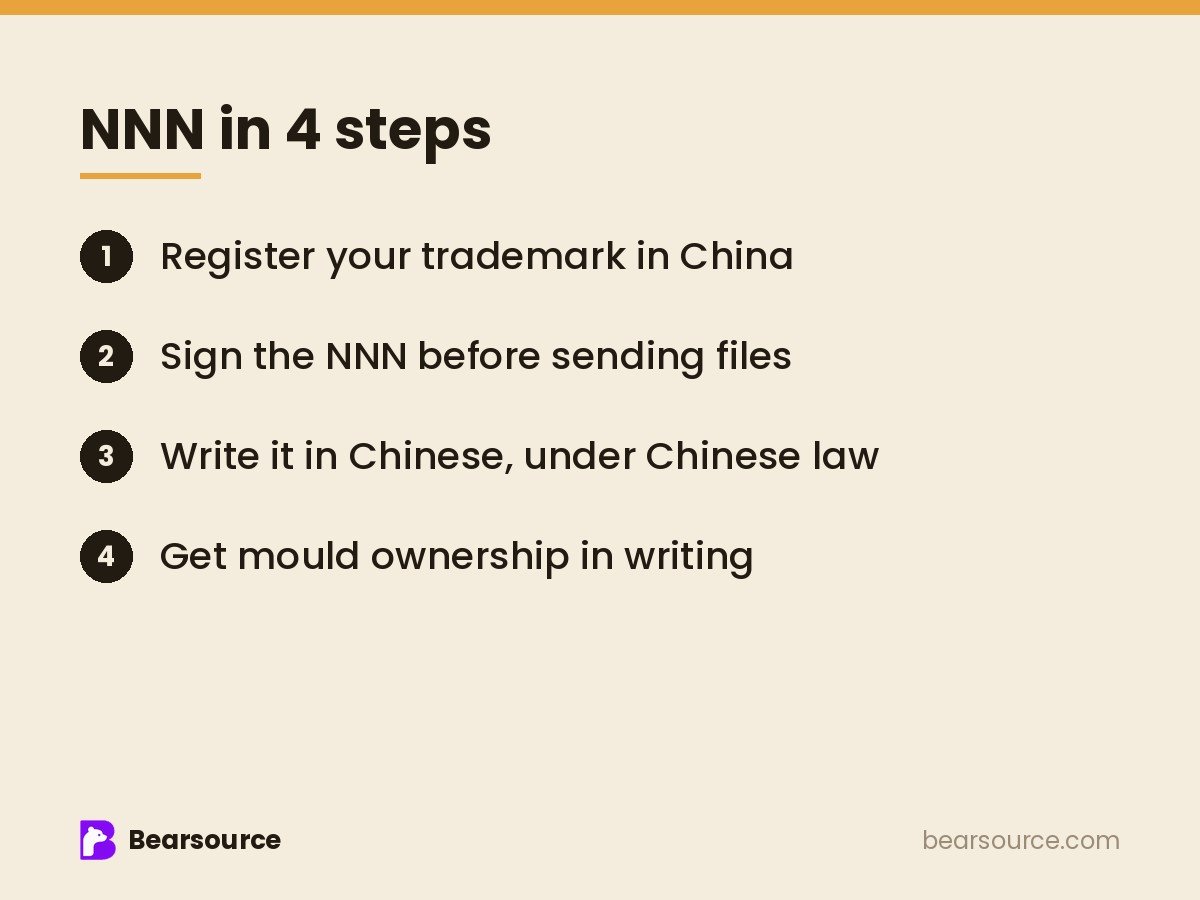
- Write it in Chinese. An English copy can sit next to it, but the Chinese version should be the one that counts.
- Choose Chinese law and a Chinese court near the factory. That's where you'd need to act.
- Name the right company. Use the factory's exact registered name from its business licence, not the name on its website.
- Include a clear penalty (often called liquidated damages), so you don't have to prove exactly how much you lost.
- Sign before you send files. Not after the first sample. Before anything sensitive leaves your hands.
A good factory will sign without fuss. If a supplier pushes back hard on a fair NNN, that tells you something about how they plan to work with you.
Other ways to protect your product
An NNN is one layer. These help too:
- Register your trademark in China. China is "first to file": whoever registers a brand name first usually owns it there, even if you used it first somewhere else. It's not expensive, and it's one of the most common mistakes we see founders skip.
- Keep your tooling in writing. If you pay for a mould, get a written agreement that it belongs to you.
- Share only what's needed. The factory making your plastic case doesn't need your full circuit design.
- Split key parts across suppliers when it makes sense, so no single factory has the whole product.
- Keep records. Dated emails, drawings and sample photos all help if you ever need to show what was yours.
When to do what
- Before the first conversation: register your trademark in China (or start the process).
- Before sending drawings or samples: sign the NNN.
- When you pay for tooling: get ownership in writing.
- During production: keep sharing on a need-to-know basis.
The bottom line
No contract makes copying impossible. But a proper NNN, written in Chinese and signed before you share anything, turns "we hope they don't" into "we can act if they do." Combined with a registered trademark, it covers most of the risk first-time founders worry about.
This article is general information, not legal advice. For your own situation, talk to a lawyer who works with China contracts.
We manage your product from idea to delivery. That includes the paperwork that protects it: NNN agreements, tooling ownership and choosing factories you can trust. You bring the idea. We build the product.
Start a Project
← Back to all articles
