30 October 2026 · Bearsource
"How many units fit in a container?" is one of the questions we hear most.
The honest answer is: it depends on your carton, not your product. Two factories can make the same product and pack it so differently that one fits 30% more into the same container.
Here's how to work it out yourself, in five minutes, with a calculator.
| Container | Inside size (approx.) | Total volume | Realistic to fill |
|---|---|---|---|
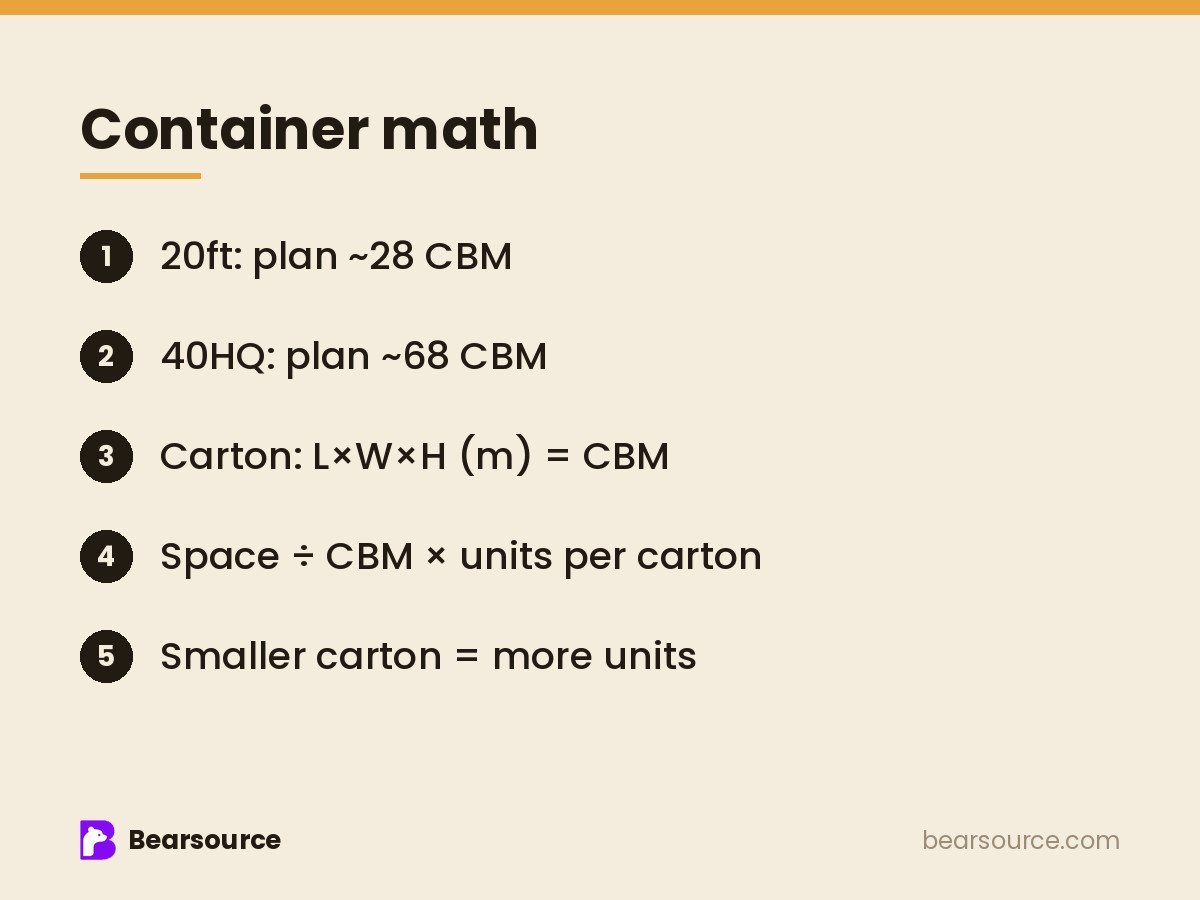
| 20ft (20GP) | 5.9 × 2.35 × 2.39 m | about 33 CBM | about 25–28 CBM |
| 40ft (40GP) | 12.0 × 2.35 × 2.39 m | about 67 CBM | about 55–58 CBM |
| 40ft high cube (40HQ) | 12.0 × 2.35 × 2.69 m | about 76 CBM | about 65–68 CBM |
Why can't you fill 100%? Because cartons are boxes, not liquid. There are always gaps at the top, sides and door. Sizes also vary a little between container owners. Plan with the "realistic" column.
Good to know: a 40ft container costs much less than two 20ft containers, and the high cube gives you about 30cm more height for a small extra cost. For light, bulky goods, the 40HQ is often the best value.
CBM means cubic metre. Measure your outer carton in metres and multiply:
Length × Width × Height = CBM per carton
Example: a carton of 60 × 40 × 40 cm
0.60 × 0.40 × 0.40 = 0.096 CBM
Divide the realistic space by your carton CBM.
20ft: 28 ÷ 0.096 ≈ 290 cartons
40HQ: 68 ÷ 0.096 ≈ 700 cartons
Multiply by the units per carton. Say 24 units per carton:
20ft: 290 × 24 ≈ 7,000 units
40HQ: 700 × 24 ≈ 16,800 units
That's your rough number. Your forwarder or factory can make an exact loading plan once the carton size is final.
Volume isn't the only limit. Heavy products (tiles, metal parts, liquids, books) can hit the weight limit before the container is full.
For heavy goods, a 20ft container is often the better choice. It fills up by weight anyway.
Ask your warehouse what they need before the factory packs.
This is the part most founders miss. Small changes to the carton can make a big difference:
Example: if the carton above could shrink to 55 × 40 × 40 cm (0.088 CBM), the 20ft count goes from about 290 to about 318 cartons. That's around 670 more units in the same container, for the same freight price.
Before production, ask for:
With these four numbers, you can plan your container, your freight cost and your cost per unit, before a single unit is made.
How many units fit in a container comes down to simple math: CBM per carton, realistic container space, units per carton. Do it early, ask about weight, and treat your carton as part of your product. It's one of the cheapest ways to lower your cost per unit.
We manage your product from idea to delivery. That includes planning cartons and packing, building loading plans with forwarders and checking the packed goods before they ship, so you get the most product into every container. You bring the idea. We build the product.
