26 October 2026 · Bearsource
Two factories quote you the same water bottle. One says $3.10. The other says $3.60.
Easy choice? Not yet. Look at the three letters next to each price. If the first quote is EXW and the second is FOB, the "cheap" one might end up costing you more.
Those three letters are called Incoterms. They decide two things:
Here are the three you'll see most often, in plain English.
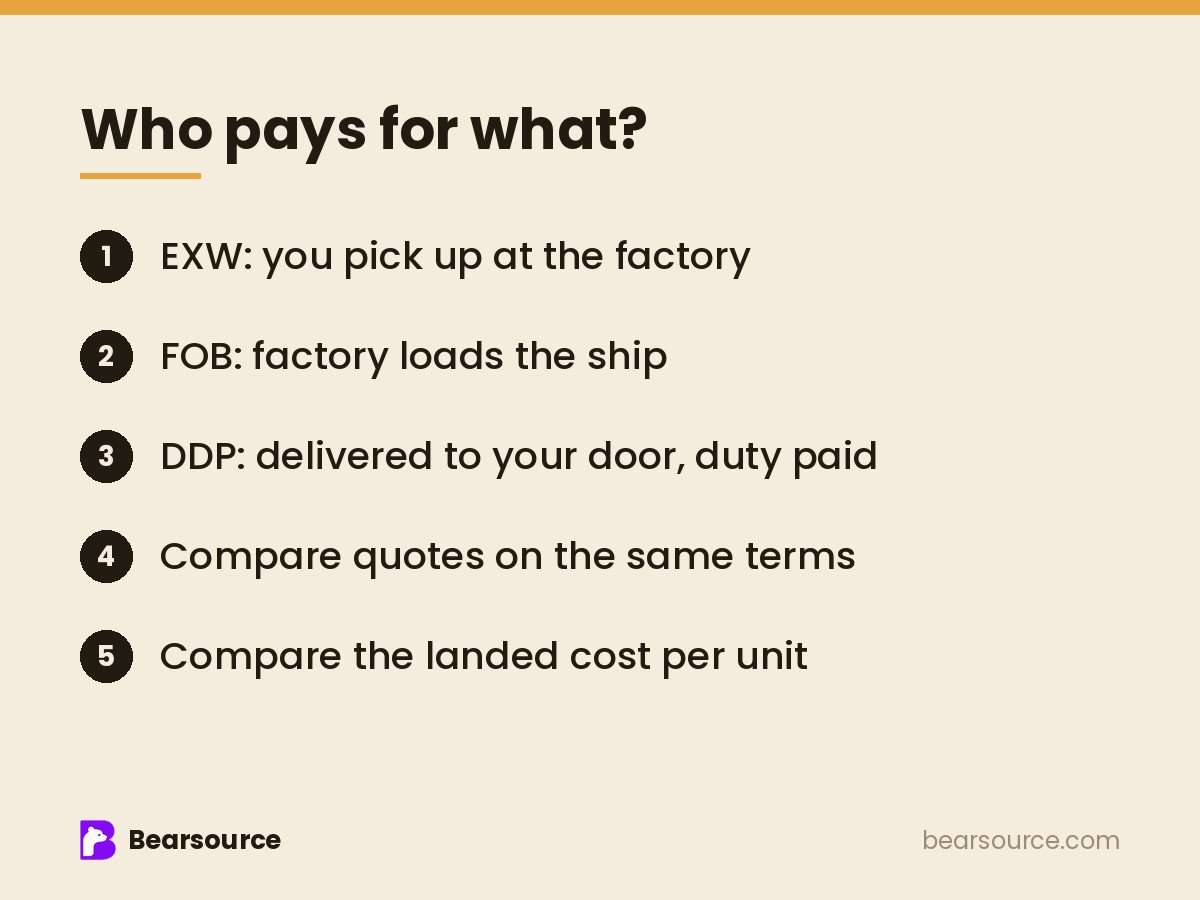
The factory makes your goods and leaves them at its door. That's where their job ends.
You pay for:
Risk moves to you: the moment the goods are ready at the factory.
Good for: experienced buyers with a freight forwarder who also handles export in the supplier's country.
Watch out: EXW quotes always look the lowest, because so much is left out. Export paperwork can be hard to sort out from abroad, and some forwarders charge extra for it.
The factory trucks your goods to the port, clears export customs and loads them onto the ship. The port is always named, for example FOB Shenzhen or FOB Ningbo.
You pay for:
Risk moves to you: once the goods are on board the ship.
Good for: most small and growing brands shipping by sea. It's the most common term for factory quotes from Asia.
Why we like it: you choose your own forwarder, so you can compare freight prices and see exactly what you pay for each step.
Small note: officially, FOB is meant for sea freight. For air or courier shipments, factories often quote FCA instead (the factory hands the goods to your carrier). The idea is similar.
The seller delivers to your address with import duty and taxes paid.
You pay for: the price on the quote, at least in theory.
Risk moves to you: when the goods arrive at your door.
Good for: first orders, small shipments and anyone who wants it simple.
Watch out:
| EXW | FOB | DDP | |
|---|---|---|---|
| Factory loads the truck | No | Yes | Yes |
| Export customs | You | Factory | Seller |
| Ocean / air freight | You | You | Seller |
| Import duty | You | You | Seller |
| Risk moves to you | At the factory | On the ship | At your door |
| Your control | High | High | Low |
| Your work | Most | Medium | Least |
Same bottle, 3,000 units, two quotes (made-up numbers to show the idea):
| Quote A (EXW) | Quote B (FOB) | |
|---|---|---|
| Price per unit | $3.10 | $3.60 |
| Pick-up, trucking, export papers | You add this | Included |
| Ocean freight | You add this | You add this |
| Duty | You add this | You add this |
Quote A only wins if the trucking and export costs come to less than $0.50 per unit. For a small order, they often don't. The only fair way to know is to add everything up.
The price on a quote is only half the story. The three letters next to it tell you the other half. Always compare quotes on the same terms, and always compare the landed cost.
We manage your product from idea to delivery. That includes checking factory quotes, setting the right shipping terms and working with forwarders, so you know your real cost per unit before you order. Not sure what's in your quote? Send it to us and we'll take a look. You bring the idea. We build the product.
