28 October 2026 · Bearsource
Your goods are ready. The factory asks: "Air or sea?"
Most founders answer with a feeling. "Air is fast, sea is cheap." That's true, but it's not enough to make a good decision. The real answer depends on how your goods are priced, and that comes down to one idea most people never learn: you don't always pay for the real weight.
Here's how freight pricing actually works.
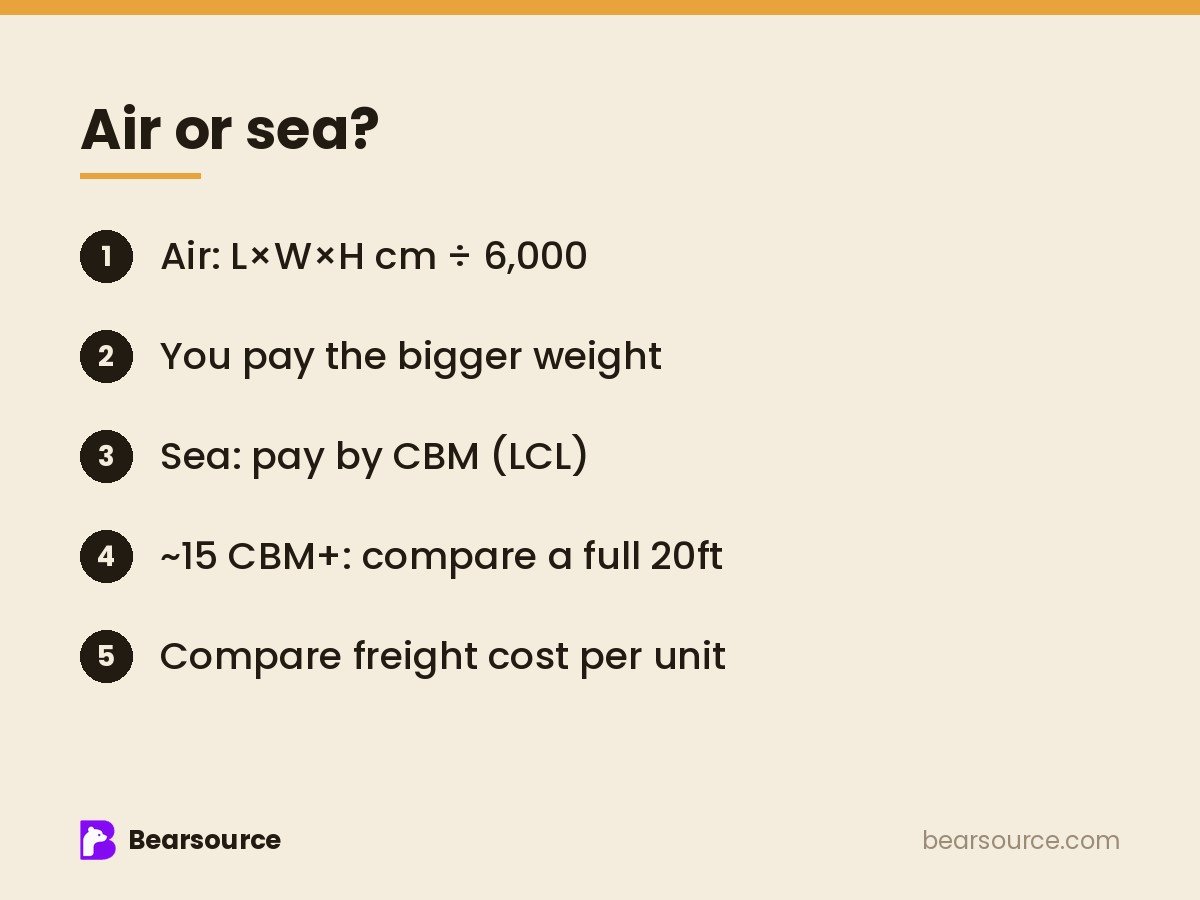
Planes run out of space before they run out of weight. So airlines charge for whichever is bigger:
The bigger number is called the chargeable weight.
How to work out volume weight for air freight:
Length × Width × Height (in cm) ÷ 6,000 = volume weight in kg
Courier services (like express door-to-door) often divide by 5,000 instead, which makes light, bulky boxes cost even more.
Example: one carton of pillows, 60 × 50 × 50 cm, weighs 8 kg.
That's why light, bulky products (pillows, plush toys, lampshades, empty bottles) are expensive to fly. And why small, heavy, valuable products (jewelry, phone parts, watches) often fly happily.
Sea freight comes in two main types.
LCL (Less than Container Load): your goods share a container with other people's goods. You pay mainly by volume, in cubic metres (CBM). Most forwarders charge a minimum, often around 1 CBM.
CBM per carton = Length × Width × Height (in metres)
Example: 0.6 × 0.5 × 0.5 = 0.15 CBM
FCL (Full Container Load): you book the whole container. You pay one price for the box, whether it's full or not.
A rough rule: once your shipment gets to around 15 CBM or more, a full 20-foot container is often worth comparing with LCL. Ask your forwarder for both prices.
For LCL, also expect extra fees at both ends: loading into the shared container, unloading, and handling at the destination warehouse. These add up on small shipments.
Every route is different, but as a rough guide from Asia:
| Typical time door to door | |
|---|---|
| Express courier | about 3–7 days |
| Air freight | about 5–10 days (with customs and delivery) |
| Sea, FCL | about 3–6 weeks |
| Sea, LCL | often 1–2 weeks longer than FCL (waiting for the container to fill, then unloading) |
Add extra time around Chinese New Year, Golden Week in October, and the busy months before the holidays.
A common plan: send a small part of the order by air so you can start selling, and the rest by sea to keep costs down. It costs a bit more overall, but it protects your launch date.
Air is fast and expensive, sea is slow and cheap, but the real decision comes from the numbers: chargeable weight, CBM and freight cost per unit. Do the math before production ends, and you'll never have to choose in a panic.
We manage your product from idea to delivery. That includes planning cartons, comparing air and sea quotes, and working with forwarders, so your goods arrive on time at a cost that makes sense. You bring the idea. We build the product.
