10 October 2026 · Bearsource
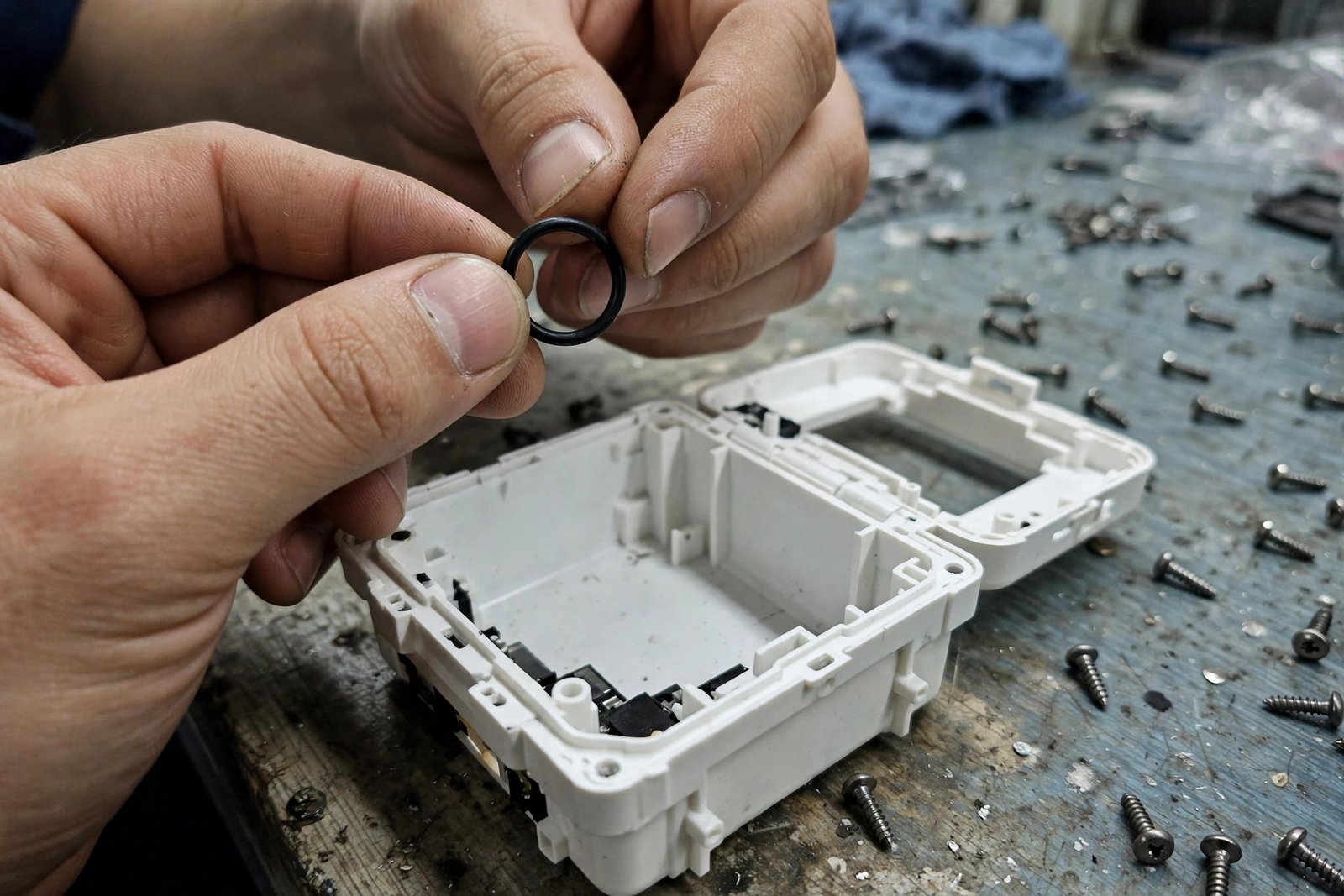
Nobody at the launch party was thinking about the gasket. They were thinking about the 50,000 units on the water, the retailer's endcap displays, the two million dollars in purchase orders. The gasket cost thirty cents. It killed all of it.
A US home-products brand — first big retail launch, a cool-mist humidifier they'd spent eighteen months developing. Tooling finished on time. The golden sample was beautiful. The pre-shipment inspection passed. Fifty thousand units at forty dollars wholesale: a $2,000,000 purchase order, sailing toward a launch date the whole company had circled in red.
Then the units reached customers, and the reviews started coming in. "Leaks all over my nightstand." Then dozens more like it. Within three weeks the retailer pulled the product from shelves, issued chargebacks, and cancelled the reorder. The launch was dead before the quarter ended.
The failure point was a silicone O-ring gasket — the seal between the water tank and the base. Thirty cents in the bill of materials, one line among hundreds. During mass production, the factory's purchasing team quietly switched the silicone compound to a cheaper one from a different supplier. Same dimensions. Same color. It passed visual inspection without a second glance.
Nobody flagged the switch, because nobody looks twice at a thirty-cent part.
The cheaper compound had lower heat resistance. Crossing the ocean in summer, inside steel containers baking in the sun, the gaskets took what engineers call a compression set — they deformed under pressure and never sprang back. By the time the humidifiers reached American bedrooms, the seals didn't seal. Every unit was a leak waiting for a nightstand.
Here's what the substitution "saved": roughly eight cents a unit, across 50,000 units. About four thousand dollars.
Here's what it cost: emergency rework and sorting in a US warehouse. Air-freighting replacement gaskets across the Pacific. More than twelve thousand units scrapped or liquidated at a loss. Retailer fines and chargebacks. The cancelled two-million-dollar reorder. And a brand whose Amazon rating never recovered — the one asset a first launch is supposed to build.
Four thousand dollars of savings. Roughly two million dollars of damage. That is the exchange rate on an uncontrolled thirty-cent part.
This is the pattern we see again and again, and it's always the same psychology: the expensive components get the scrutiny — the motor, the PCB, the battery — while the gaskets, screws, and adhesives sail through on trust. But a product doesn't fail at its most expensive part. It fails at its weakest uncontrolled part. And the parts nobody watches are exactly where quiet substitutions happen.
The factory didn't set out to destroy the launch. Someone in purchasing found a cheaper compound, the dimensions matched, and nobody in the chain had a reason — or a rule — to stop it. That's how most quality disasters actually happen: not sabotage, just an undocumented decision about a part nobody thought mattered. It's one of the reasons our factory audit checklist covers purchasing controls, not just production lines.
1. Lock the bill of materials — including the cheap stuff. Every component gets an approved vendor and an approved specification. No substitutions without written sign-off from the buyer. Especially the thirty-cent parts. Especially those.
2. Incoming QC covers everything, not just the expensive parts. A ten-minute durometer hardness test on the gasket compound would have caught this before a single unit was assembled. The test costs less than the gasket.
3. Test what ships, not what was approved. The golden sample was perfect — it was made with the original compound. Production-line samples, pulled from the actual run and stressed the way a shipping container stresses them (heat-aged, stacked, vibrated), would have told the truth.
4. Watch material changes like a hawk. Any change of supplier, compound, or formulation — at any price point — triggers re-approval and re-testing. Make this a contractual term, not a hope.
5. Be there when it matters. First production run, any material change, pre-shipment: these are the moments that decide whether you get what you approved. Someone competent needs to be on the floor — you, or someone you trust.
"It's only thirty cents."
We've heard it from buyers, from factories, from purchasing managers. It sounds like common sense. It is the most expensive sentence in manufacturing — because a part's price has no relationship whatsoever to its failure cost. A thirty-cent gasket can sink a two-million-dollar launch just as easily as a thirty-dollar motor. Easier, actually: nobody's watching the gasket.
The brands that survive their first big launch aren't the ones with the biggest QC budgets. They're the ones who understood that quality control isn't about the price of the part — it's about the price of being wrong.
What is a "golden sample" and why isn't it enough?
The golden sample is the perfect reference unit the factory builds for your approval. It's necessary — but it only proves the factory can build it right, not that 50,000 units were built right, with the same materials. You need production-line checks on top of it.
How do I stop suppliers from substituting materials?
Contractually: a locked BOM with approved vendors and a written-change-approval clause. Practically: incoming QC on materials (even cheap ones) and someone on the floor during the first production run. Trust the relationship; verify the compound.
What's a compression set, in plain terms?
A rubber seal gets squeezed into shape and is supposed to spring back. A cheap or wrong compound stays squashed — like a cheap mattress that keeps your body dent. Once it stops springing back, it stops sealing.
How much does incoming QC on small parts cost?
Almost nothing relative to the risk. A handheld durometer (hardness tester) costs under $100, and a compound check takes minutes. Compare that to air-freighting 50,000 replacement gaskets across the Pacific.
About to scale up your first production run? Tell us what you're making — we'll lock down your BOM and put QC where the quiet substitutions happen.
