27 September 2026 · Bearsource
MOQ stands for minimum order quantity. It's the smallest number of units a factory will make for you in one order. It's often the first number that surprises a new founder or creator — and the one that decides whether your first run is realistic.
This guide explains why MOQs exist, what numbers to roughly expect, and how to get a lower one without getting burned.
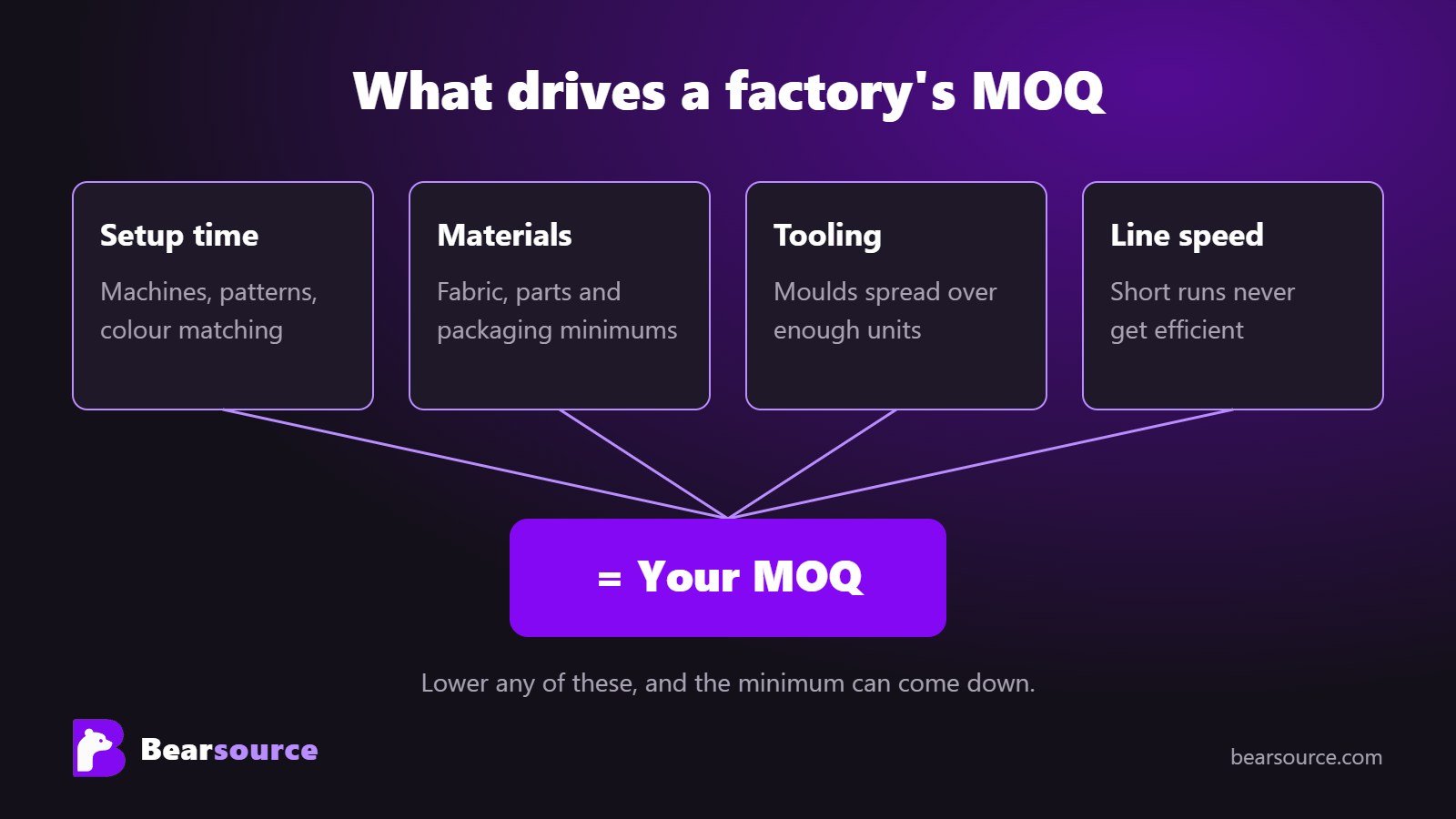
A factory isn't being difficult when it sets an MOQ. Every order has costs that are the same whether you make 50 units or 5,000:
The MOQ is simply the point where the order becomes worth the factory's time.
Every factory is different, so treat these as rough starting points, not promises:
| Printed or embroidered blanks (tees, hoodies, caps) | 50–300 pcs |
| Custom cut-and-sew apparel | 300–1,000 pcs per style |
| Bags, drinkware, simple home goods | 500–2,000 pcs |
| Jewellery and small accessories | 100–500 pcs per design |
| Consumer electronics | 1,000–5,000+ pcs |
| Custom printed packaging | 1,000–3,000 pcs |
Newer or smaller factories are often more flexible. Big, busy factories usually are not.
This is where first-timers get caught. "MOQ 500" can mean very different things:
Always ask: "Is that per style, per colour, or total? And do any materials or packaging have their own minimum?"
1. Use the factory's existing materials. Choosing a fabric, colour or component the factory already stocks removes the material minimum — often the biggest barrier.
2. Start with fewer colours and sizes. One style in two colours is far easier to approve than four styles in six colours. Expand once you've sold through.
3. Customise a proven base. Adding your logo, trims or packaging to an existing product needs much less than a design built from scratch.
4. Pay a bit more per unit. Many factories will accept a smaller run for a small surcharge. Ask directly: "What would the price be at 300 instead of 1,000?"
5. Keep packaging simple for run one. A stock mailer with a printed sticker or insert can replace a custom box until volume justifies it.
6. Show a realistic plan. Factories take small orders when they believe more will follow. A clear reorder plan builds that trust.
7. Work with someone who has relationships. Factories are more flexible with partners who bring them steady work. This is a big part of what a sourcing partner does.
A low MOQ isn't always a win. Here's a simple example:
| 300 units at $12.00 | $3,600 |
| 1,000 units at $8.50 | $8,500 |
The small run needs less cash, but every unit earns you $3.50 less. That's fine for testing demand — just price your product so it still makes money at the smaller run.
Also watch for factories that accept any quantity with no questions asked. Sometimes that means they plan to subcontract your order, or cut corners on materials to make a tiny run pay.
MOQ isn't a wall. It's a starting point for a conversation. Understand what's driving the number, simplify your first run, and ask the right questions — and a first order that felt impossible often becomes realistic.
Need help with your first production run? We handle sourcing, sampling, quality control and production management for founders, creators and ecommerce brands.
Start a project