31 October 2026 · Bearsource
Many first-time founders send the factory a mood board, a few photos and a message: "Can you make something like this?"
The factory says yes. The first sample arrives. It's close, but the fit is off, the logo is the wrong size, and the zipper is a different colour. So you send notes. Sample two. More notes. Sample three.
Most of those rounds can be avoided with one document: a tech pack.
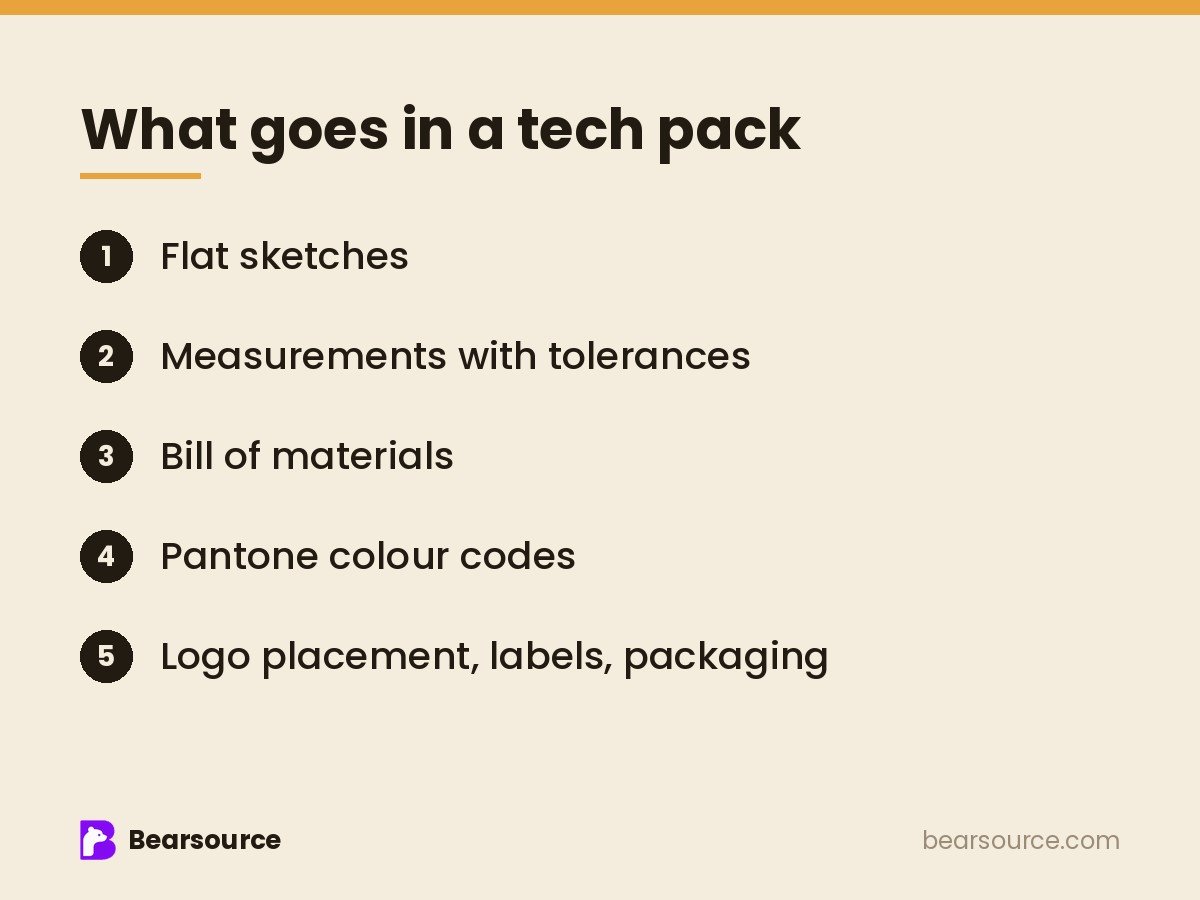
A tech pack (technical package) is the instruction manual for your product. It tells the factory exactly what to make: every measurement, material, colour, label and detail.
Think of it this way: the factory shouldn't have to guess anything. Every guess is a chance for a mistake, and every mistake is another sample round.
Tech packs are best known in apparel, but the same idea works for bags, accessories and hard goods. For hard goods, it's often called a spec sheet or product specification, usually with a 3D file attached.
Clean front, back and side drawings of the product. Not a pretty illustration, a technical drawing with every seam, pocket and detail shown.
Every key measurement, with a tolerance. For example: chest width 52 cm, tolerance ±1 cm. For apparel, this includes every size (called grading).
Without tolerances, the factory can't know what "close enough" means. Neither can your inspector.
A list of every material and part:
Name the supplier or quality where it matters (for example, a specific zipper brand or size).
Use a colour standard like Pantone codes, not "navy" or "sage green". Your navy and the factory's navy are probably not the same.
How it's put together: stitch type, seam finish, stitches per inch, where reinforcements go. Close-up drawings help a lot here.
Logo files plus exact placement: size, and distance from a fixed point (for example, "8 cm below the collar seam, centred"). Note the method too: print, embroidery, patch, emboss or engrave.
Care label, size label, country of origin, brand label, hang tag, polybag, carton marking. Many of these have legal requirements depending on where you sell.
A simple table of what changed and when. When you're on version 4, everyone should be working from version 4.
Not necessarily. You can:
The best tech packs are made with the factory's input. The factory knows what's easy to make, what costs more, and where problems usually start.
A tech pack turns "something like this" into "exactly this". It costs a little time up front and saves a lot of time, money and frustration on samples. And later, it's the document your inspector uses to check mass production.
We manage your product from idea to delivery. That includes turning your idea into a clear tech pack or spec sheet, checking it with the factory, and using it to inspect every sample and every production run. You bring the idea. We build the product.
