It usually starts with one message. A customer says the charger got hot. A parent says a small part came off the toy. A review mentions a burn.
Most founders' first instinct is to hope it's a one-off. Sometimes it is. But if it isn't, how fast and how well you act in the first days decides how much it costs you, and whether customers trust your brand afterwards.
Here's how product recalls work, in plain English, and what you can do today so you're ready.
This article is general information, not legal advice. If you think you may have a safety problem, talk to a product safety lawyer early.
What is a recall?
A recall is when a company takes action to fix a safety problem with a product that's already been sold. That might be:
- Refund: the customer returns the product for their money back
- Replacement: they get a safe product instead
- Repair: a fix, a new part, or a repair kit
It also includes stopping sales and removing stock from shelves and warehouses.
The US: the 24-hour rule
In the US, most consumer products fall under the Consumer Product Safety Commission (CPSC). Manufacturers, importers, distributors and retailers all have a duty to report.
You must report to the CPSC within 24 hours of getting information that a product:
- has a defect that could create a substantial risk of injury, or
- creates an unreasonable risk of serious injury or death, or
- doesn't meet a CPSC safety rule or standard
Some other events, like certain choking incidents with small parts from toys, must be reported too.
A few things to know:
- You don't need confirmed injuries to report. A reasonable sign of a hazard can be enough.
- If you're truly unsure, the CPSC says you can investigate for a reasonable time, normally not more than 10 working days.
- The CPSC's own advice: when in doubt, report.
- Not reporting can lead to serious civil or criminal penalties.
Fast Track: if you report and you're ready to act, the CPSC's Fast Track program lets you start a recall within 20 working days, working with CPSC staff. Fast Track usually skips the long review of whether the product is legally "defective". It's often the quickest way to fix the problem and move on.
The EU: stricter recall rules
In the EU, the General Product Safety Regulation (GPSR) sets the rules for most consumer products. Key points:
- Recalls of dangerous products must be notified through the EU's Safety Business Gateway to each country where the product was sold
- Customers you can contact directly (online buyers, registered users) must be told without delay
- Customers must usually be offered a choice of at least two remedies: repair, replacement or refund. The remedy must be free, and you pay for returns
- Recall notices should be clear. Wording like "voluntary" or "precautionary", which makes the risk sound smaller, should be avoided
- The EU has a standard recall notice template you can use
The first 48 hours
Hour 0–4: get the facts
- Collect every report: photos, dates, how the product was used
- Find the batch, lot or date code of the affected units
- Keep the returned product. Don't throw it away
Hour 4–24: decide
- Is this a safety issue or a quality issue? (A scratch isn't a recall. A hot battery might be.)
- Talk to your product safety lawyer and your insurer
- Ask the factory for production records and test reports for that batch
- In the US, remember the 24-hour reporting clock
Hour 24–48: act
- Stop selling affected stock: your website, Amazon, and tell retailers
- Put warehouse stock on hold
- Report to the authorities if required
- Prepare a clear, honest message for customers
What a recall really costs
The refund is often the smallest part. The full cost usually includes:
- Return shipping and collecting product
- Replacement units, or the refund itself
- Destroying or reworking stock
- Lab testing to find the root cause
- Legal advice
- Retailer chargebacks and penalties
- Lost sales, and lost trust
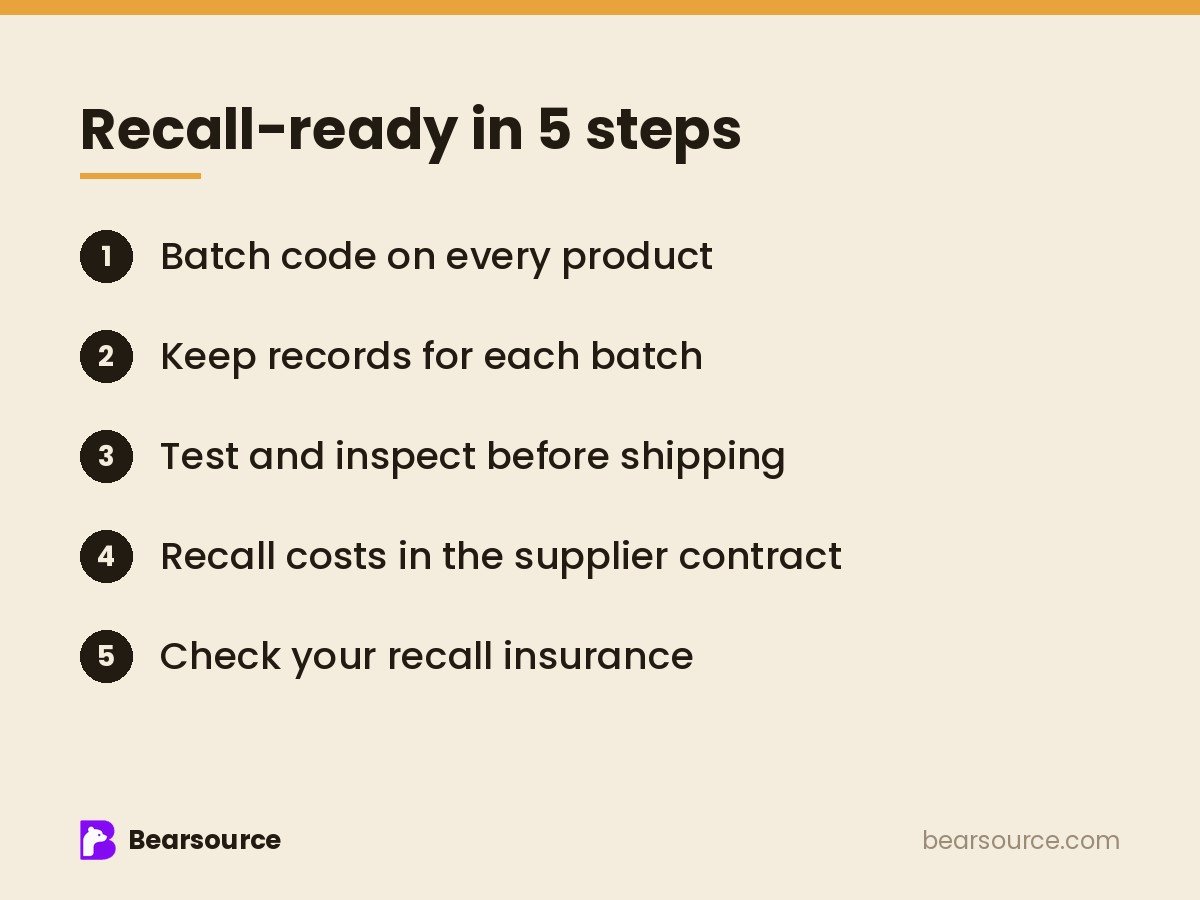
Prepare now: 7 things to do before you ever need a recall
- Put a batch or date code on every product and carton. If you can't tell which units are affected, you may have to recall all of them.
- Keep production records for each batch: materials, test reports, inspection reports.
- Test before production, not after. Use an accredited lab for the safety tests your market requires.
- Inspect before shipping. Problems caught at the factory cost a fraction of problems caught by customers.
- Know who your customers are. Online orders and product registration make it possible to contact buyers directly.
- Put it in the contract. Your supplier agreement should say who pays if a recall is caused by a manufacturing defect.
- Check your insurance. Product liability insurance and product recall insurance are not the same thing. Ask your broker what's covered.
The bottom line
Recalls are rare for brands that test, inspect and keep good records. But nobody can promise zero. The brands that come through a recall well are the ones that already know their batch codes, have their records ready, and act honestly and fast.
We manage your product from idea to delivery. That includes arranging safety testing, inspecting goods before they ship, and setting up batch codes and production records, so problems are caught early and traced quickly if something ever goes wrong. You bring the idea. We build the product.
Start a project
← Back to all articles 