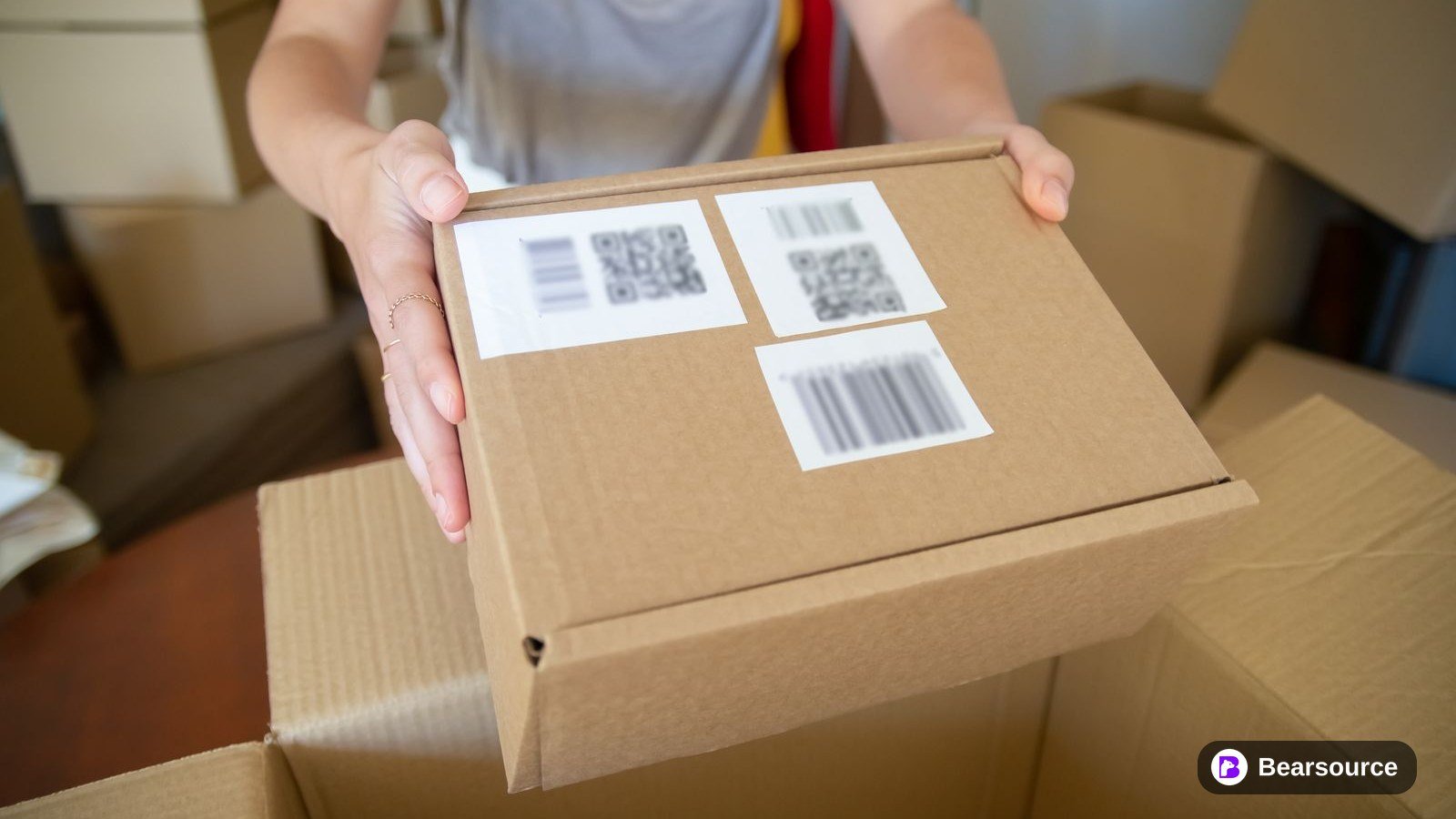
Your container cleared customs. Your product passed inspection. Then Amazon's fulfilment centre rejects the shipment, or receives it so slowly your launch window evaporates — because of a barcode, a carton label, or a poly bag without a suffocation warning. FBA prep is the unglamorous discipline between “goods arrived in the country” and “inventory available to sell”, and most first-time importers discover it exists by paying for its absence.
What Amazon actually requires
Fulfilment by Amazon runs on machine-readable certainty. The core requirements for most products:
- Unit barcodes: every sellable unit needs a scannable FNSKU label (or a manufacturer barcode if enrolled and eligible) — covering, not sitting next to, any other barcode on the packaging
- Carton labels: every carton in the shipment carries its Amazon shipment label, applied per the shipment plan you created — cartons and contents must match the plan exactly
- Prep by category: poly-bagging (with suffocation warnings) for soft goods and small parts, bubble protection for fragile items, taping and sealing rules, expiration-date labelling for dated products, “sold as set” labelling for bundles
- Carton and pallet specs: weight and dimension limits per carton, standard pallet configurations for palletised shipments, no mixed pallets unless the plan says so
- Appointment and carrier rules: deliveries arrive through Amazon's carrier systems, on booked appointments — a truck that simply shows up does not get unloaded
The rules change and differ by marketplace (US, EU and UK each have their variations). The operational point is permanent: Amazon does not fix non-compliant prep at the dock. Shipments are refused, returned at your cost, or received slowly while exceptions are untangled — and unplanned prep by Amazon, where offered, is slow and billed per unit.
Where a 3PL fits
Factories in China can do a lot of FBA prep at origin — FNSKU labels, poly bags, carton labels — and for stable, high-volume products that is the cheapest place to do it. A destination-country 3PL (third-party logistics provider) earns its place for everything origin prep cannot cover:
- Receiving and checking the import shipment against the packing list — carton counts, damage, quantity surprises discovered here, not at Amazon
- Prep and rework: labelling, bagging, bundling, kitting, relabelling (including the classic: marketplace-specific labels for US vs EU stock from one import)
- Staged release to FBA: holding bulk stock and feeding Amazon in tranches — managing placement fees, storage limits and seasonal stock curves instead of one giant check-in
- Returns and removals handling: the back end of FBA life that every growing seller eventually needs
The mistakes that cost the season
- Creating the shipment plan after the goods ship: carton labels come from the plan; labelling at destination without it is rework by definition. The plan — quantities, carton contents, destination FCs — should exist before cartons are sealed
- Factory-applied FNSKUs for the wrong marketplace or over last season's packaging barcode: units arrive unscannable and get manually processed at your expense
- Sending the entire import to Amazon: storage fees, capacity limits and no buffer for your other channels. The 3PL-as-reservoir model exists because this hurts
- Ignoring expiration and date rules on anything Amazon treats as dated — including some cosmetics and supplements — where non-compliance means destruction, not return
- Assuming EU = US rules: pan-European FBA has its own labelling and VAT geography; stock prepped for .com is not automatically stock ready for .de
The bottom line
FBA prep is a specification, like your product specification — decided early, written down, and executed where it is cheapest: standard prep at the factory, flexible work at a 3PL, nothing improvised at Amazon's dock. Sellers who treat the last mile into the fulfilment centre as part of production stop paying the tuition of refused and crawling shipments.
Your import is not finished when the container lands. As a production-management partner, we specify FBA prep at the factory where it belongs, align carton labelling with your shipment plan before sealing, and coordinate 3PL receiving at destination — so goods become sellable inventory on schedule. You bring the product. We take it from idea to shipment.
Start a Project
← Back to all articles 