23 October 2026 · Bearsource
Custom drinkware is one of the most popular products for brands, creators and gifting. It's easy to picture: your logo on a nice tumbler. But it's also easy to get wrong. A lid that leaks or a print that scratches off turns a great gift into a bad review.
Here's what to know before you order.
| Material | Good points | Watch out for |
|---|---|---|
| Stainless steel (18/8 or 304) | Durable, keeps drinks hot or cold with double walls | Cheaper steel grades, weak vacuum seal |
| Plastic (e.g. Tritan) | Light, clear, low cost | Must be food-safe and BPA-free |
| Glass | Clean taste, premium feel | Breaks, heavier to ship |
| Ceramic | Classic mugs, great for print | Chips, not insulated |
For insulated tumblers, ask whether it's double-wall vacuum insulated, not just "double wall." The vacuum is what keeps drinks cold.
Anything that touches a drink must be made from food-safe materials: the body, the lid, the seal and any straw. For the US, that means meeting FDA food-contact rules. For Europe, there are separate EU rules.
Ask the factory for material test reports early, and make sure they cover the coatings and the lid, not just the steel.
Each has its own cost and minimum. Custom powder-coat colours usually have a higher MOQ than stock colours.
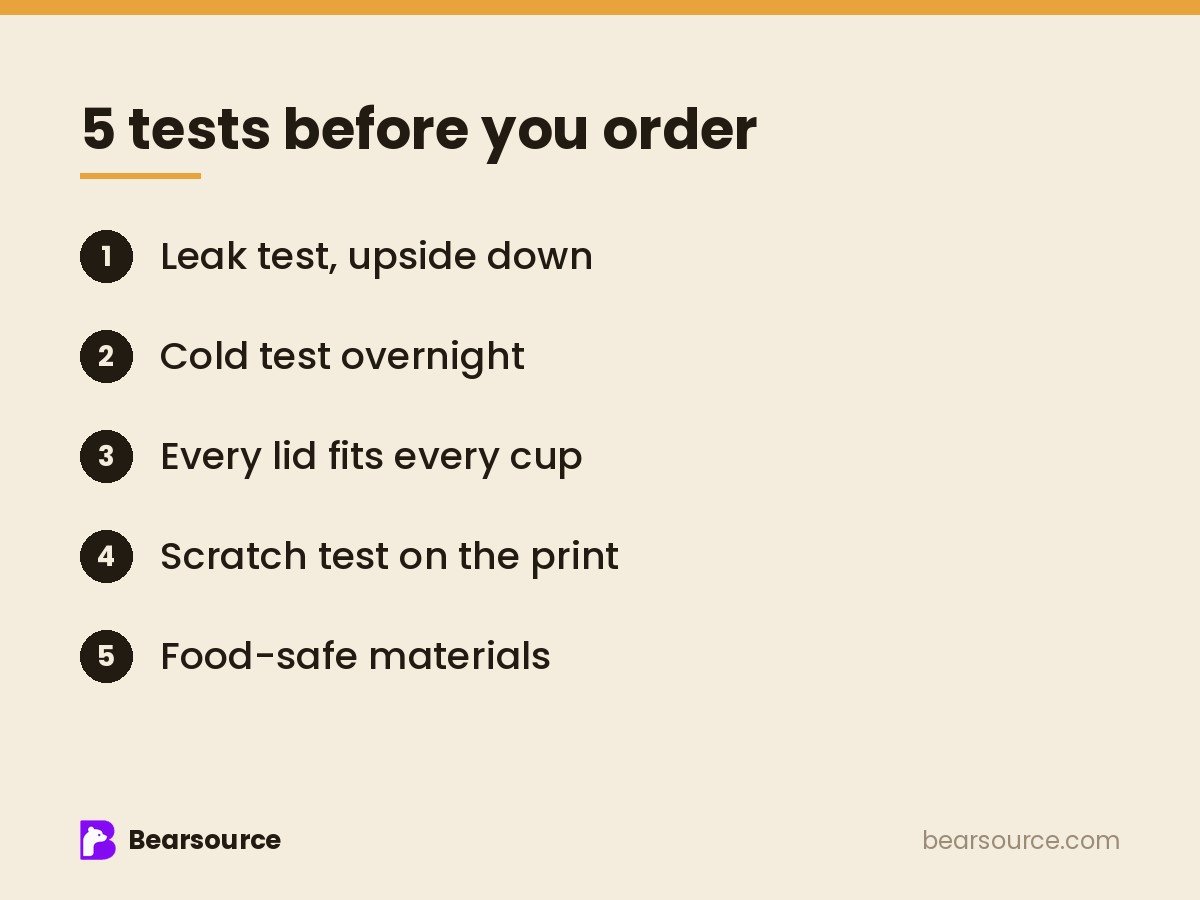
Do these on samples first, then check again on production units before shipping.
Drinkware is heavy and can dent or break. Use individual boxes with inserts, a strong outer carton, and drop-test a packed unit before you approve.
Stock shapes with your logo can start quite low. Custom shapes need a mould and take much longer. As a rough plan: a few weeks for samples, then production and shipping. Allow extra time for custom colours and around Chinese New Year.
A tumbler is simple to design and easy to get wrong. Pick a food-safe material, test leaks, lids and print on real samples, and check production units before they ship.
We manage your product from idea to delivery. For drinkware, that means choosing the right factory and materials, arranging food-safety testing, and checking leaks, lids and print before anything ships. You bring the idea. We build the product.
