29 October 2026 · Bearsource
Jewelry is a favourite first product for creators and fashion brands. It's small, light, easy to ship, and the margins can be great.
It's also one of the easiest products to get wrong. The photos look perfect. Then, three weeks later, customers send pictures of green fingers and faded gold.
Almost every one of those problems comes from three choices: the base metal, the plating, and how it was tested. Here's how to get them right.
The base metal is what's under the surface. It decides the price, the weight, and what happens when the plating wears off.
| Base metal | Good points | Watch out for |
|---|---|---|
| Stainless steel (316L) | Strong, doesn't rust, good for everyday wear | Harder to make fine details |
| Sterling silver (925) | Real precious metal, great for "demi-fine" | Tarnishes, higher cost |
| Brass | Easy to shape, good details, takes plating well | Can turn skin green if plating wears off |
| Copper | Warm colour, low cost | Turns skin green, tarnishes |
| Zinc alloy | Cheap, good for cast pieces | Lower-end feel, check for lead and cadmium |
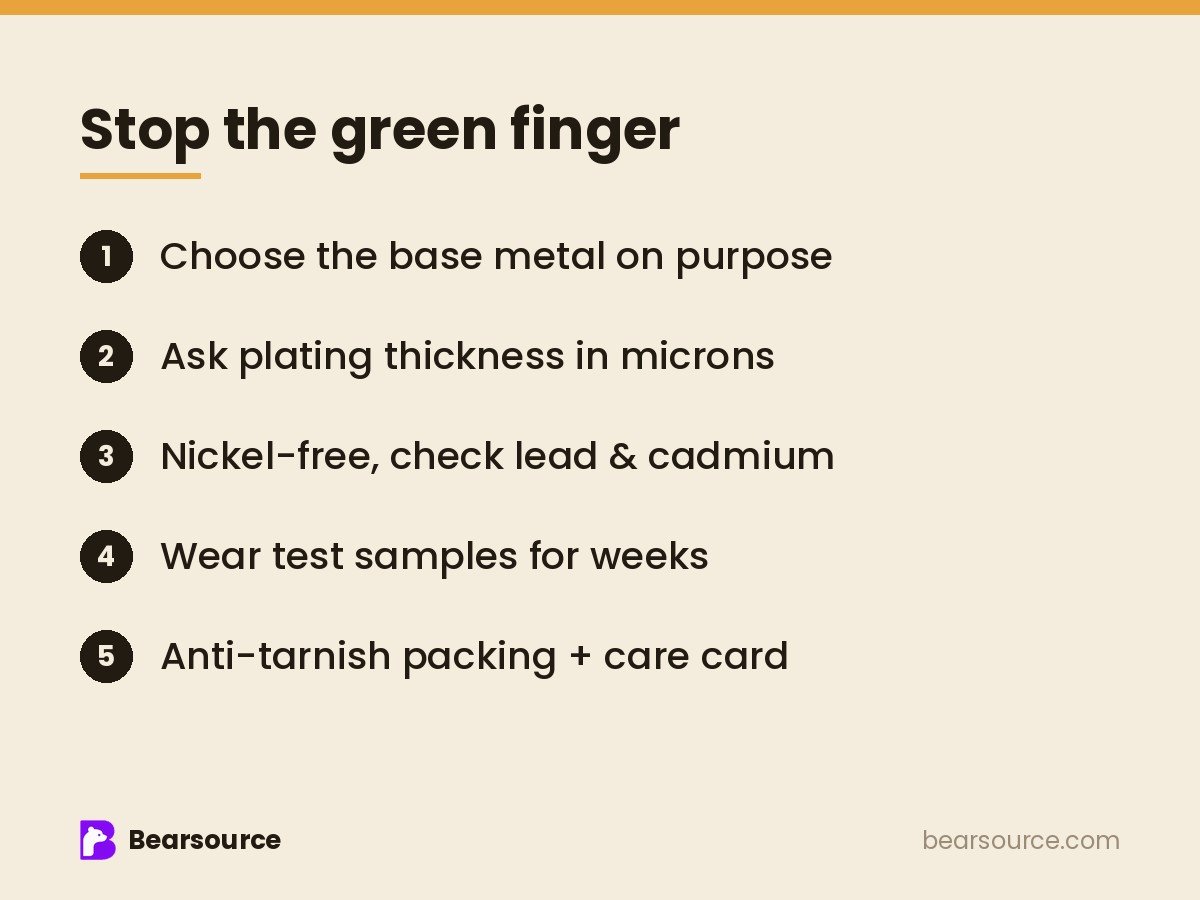
The honest truth: the "green finger" problem usually comes from copper-based metals (brass, copper) under thin plating. When the plating wears through, the copper reacts with skin and sweat.
Plating is a thin layer of gold, silver or rhodium on top of the base metal. Its thickness is measured in microns (thousandths of a millimetre).
Always ask the factory: "What is the plating thickness, in microns?" Put the answer in your order. If they can't answer, that's your answer.
Jewelry touches skin for hours, so many markets limit certain metals.
Rules are detailed and change over time. Use an accredited testing lab and check the current requirements for each market you sell in.
Don't judge jewelry on day one. Judge it on day 30.
Simple tests to run on samples:
Stock designs with your logo tag or engraving can start small. Custom designs need moulds or tooling (casting or stamping), and the MOQ is usually per design and per colour. Plan for sampling, a few weeks of wear testing, then production. Plating colour is one of the hardest things to match between batches, so keep a golden sample for each colour.
Jewelry turns green because of a cheap base under thin plating, and nobody tested it on real skin. Choose your base metal on purpose, ask for the plating thickness in microns, follow the nickel and lead rules for your market, and wear your samples before you order.
We manage your product from idea to delivery. For jewelry, that means choosing the right metals and plating, arranging lab tests, managing samples and wear tests, and checking every batch before it ships. You bring the idea. We build the product.
