13 October 2026 · Bearsource
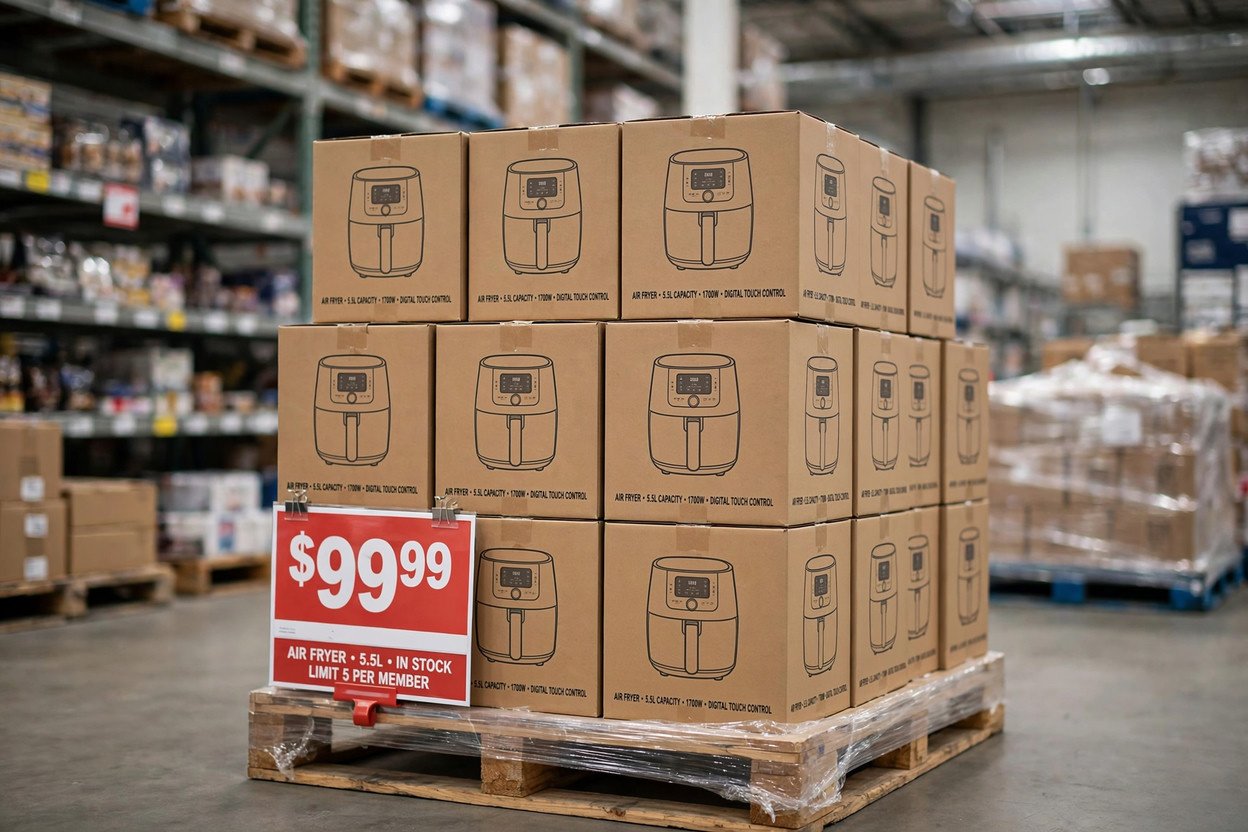
Nobody at the factory was thinking about $99.99. They were thinking about heating elements, baskets, and cartons. But $99.99 had already been decided — in a buying office thousands of miles away — and it was about to decide everything the factory was allowed to charge.
A 5-quart digital air fryer. The kind that sells by the pallet without anyone writing a love letter about it. On the warehouse floor it sits at $99.99 — the number the buyer circled. Not the factory's number. The buyer's. That number was fixed before a single tool was cut, before any quote was requested, before anyone chose a heating element.
Most founders do the math forward. They get a factory quote, add freight, add duty, add their margin, and arrive at a price — then they go shopping for a retailer who will take it. That's backwards. Literally.
Costco's rule is famous: they cap their markup at about 14%. It's not a starting bid. Nobody negotiates it. So start at the shelf and subtract:
| Costco shelf price | $99.99 |
| Minus Costco's 14% markup → what Costco pays the brand | $87.71 |
| Minus the brand's 25% margin → the brand's landed-cost ceiling | $65.78 |
| Minus ocean freight, duty, warehousing, inland (~$11) | $54.78 |
| The most the factory can charge (FOB) | ~$55 |
Read that last line again. Every feature you want — the digital display, the extra presets, the ceramic-coated basket — has to fit inside ~$55 at the factory gate. Not "around" it. Inside it. The shelf price doesn't care about your bill of materials.
This is the single most expensive misunderstanding in product sourcing. The founder starts at the factory and adds up. The retailer starts at the shelf and subtracts down. The factory's price isn't where the math begins — it's where the math ends, after everyone else has taken their cut.
So when a factory quotes you a number that doesn't fit under your backward math, you don't have a pricing problem. You have a product problem. The quote is telling you the truth: this product, as designed, cannot survive this channel.
1. The retailer's cap. Costco: 14%. It's the walls of the room. Every retailer has one — some publish it, most don't — and it never moves because you asked nicely.
2. The brand's margin. Twenty-five percent keeps the lights on: marketing, returns, chargebacks, the team answering the phones. Squeeze it and the business quietly bleeds out six months after launch.
3. The middle bite. Freight, duty, warehousing — the part everyone underestimates and the part that moves. Fuel goes up, tariffs shift, and suddenly the $9 bite is $12 and your FOB ceiling just dropped three dollars with nobody touching the product.
Here's the part the math doesn't show. Costco carries roughly 3,000 SKUs. A Walmart Supercenter carries more than 100,000. That means every product on the Costco floor won a fight to be there — and for yours to get in, it has to be good enough to kick something out.
Surviving the margin math gets you into the conversation. It doesn't get you the pallet. Costco buyers aren't filling shelves; they're curating 3,000 winners. Your product has to be outstanding — visibly better value than anything else at that price, moving fast, coming back rarely.
This is why "good enough and cheap" dies at Costco. Cheap is table stakes — everything there is cheap. What wins is the product members tell their friends about. The one with the crowd around the demo. The one that sells out before the weekend.
So the real test is two gates, not one: can your product survive the subtraction — and is it remarkable enough to take someone else's place?
Do the backward math before you request a single quote. If the FOB ceiling is $55 and every factory comes back at $60 and up, you have exactly three moves: redesign the product, change the channel, or walk away. What you cannot do is negotiate the shelf price upward — Costco does not care about your BOM, and neither does any other buyer.
The founders who survive warehouse retail aren't the ones who found the cheapest factory. They're the ones who did the subtraction first — and designed a product that could live inside the answer.
The shelf price is the boss. Everything else is subtraction.
Is Costco's 14% really a hard cap?
Yes — famously. Around 14% markup on branded goods, about 15% on Kirkland. It's their entire business model, not an opening offer. That's what makes the backward math so reliable: the first subtraction never changes.
What if my product can't hit the FOB target?
Three options: redesign it (fewer features, simpler controls, cheaper packaging), sell it somewhere with fatter margins, or walk away before you've spent tooling money. The worst option is hoping the math works out later. It won't.
Does this work for retailers other than Costco?
Yes. Every retailer has a margin structure — big-box, grocery, DTC, Amazon. Costco's is just the most transparent and the most brutal, which makes it the best teacher. Learn the subtraction here and you can run it anywhere.
Selling into warehouse clubs? We'll run the backward math on your product before you commit to a factory — so the quote you accept is one the shelf price can survive.
